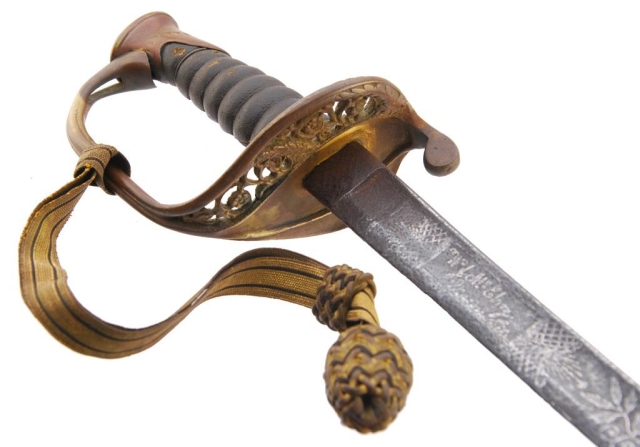
 ARIZONA SWORDS
 ARIZONA SWORDS
Confederate Edge Weapons

CLICK BELOW BUTTONS TO SEE AVAILABLE ITEMS












Beware of fake and misrepresented edge weapons.

Click above to see examples of known fakes!
*******************************************************************************************************************************
CLICK IMAGES TO SEE MORE PHOTOS
*******************************************************************************************************************************
|
|
|
|
|
|
|
|
|
|
|
|
C509. COLUMBUS, GEORGIA - NAVAL IRON WORKS CUTLASS: This Confederate naval cutlass with a cylindrical, grooved grip and wasp-waisted blade with a flat S-curved guard was made at the Columbus, Georgia, Naval Iron Works. This was the old Columbus Iron Works, a large operation founded in 1853 and leased by the Confederate navy in 1862, producing ordnance, steam engines, machinery, and armor plate, and helped to build the CS gunboat Chattahoochee and the ironclad Muscogee among other activities. The blade is smooth metal with a pleasing silver gray to dark gray patina with a good edge and tip. It has the characteristic median ridge and pronounced wasp waist blade. The counterguard is iron with a broad, flat, recurved-S shape that is unique to this pattern. The grip is cylindrical, but with flattened sides to give a better grip and an iron ferrule at the guard, and a steel washer secured with a steel square nut to secure the blade tang. Overall length is 22 inches with a blade length of 16 1/3 inches long. Shipping & Insurance included. $2300.00
*****************************************************************************************************************************
|
|
|
|
|
|
|
|
|
|
|
|
 C516.LEECH &
RIGDON - SELMA ARSENAL STYLE CONFEDERATE MADE
NAVAL CUTLASS: This is one of the rarest of Confederate naval cutlasses. It is generally referred to as a Selma Arsenal cutlass due to
the excavated examples found in and around Selma, Alabama. Research done by Bill Beard and Kent Wall leaves no doubt
that this pattern was by Leech and Rigdon. In the fall of 1862, the
Confederate Arsenal at Columbus, Mississippi was threatened by infamous Union
General W. T. Sherman. Consequently, the entire arsenal packed up and
moved to Selma Alabama. Leech and Rigdon moved to Selma at the same time
and operated there until March of 1863. It is believed that most, if not all, of the
company’s naval cutlasses were made prior to the company’s move to Greensboro,
Georgia. On page 199 of Shannon Pritchard's book, “Collecting
the Confederacy,” he explains how it was most likely made at the Selma Arsenal
in Selma, Alabama. The blade is full length at 21 1/2 inches and 1-3/4 inches
at the widest point. It has some pitting and period sharpening. The guard on
these cutlasses are very distinctive and are made by forming a piece of sheet
brass that is rolled on the edges and has raised ribs to reinforce the guard
strength. The quillion on most of these cutlasses are lead reinforce since this
was a weak point. The handle of the sword is made of cast brass and has
wonderful casting details common to a Southern made weapon. The handle is made
to look like a fish scale pattern. When you look closely, you can see the pins
that hold the handle in place. This is a beautiful 100% original Confederate
naval cutlass that displays well from all angles. Shipping & Insurance
included. $2700.00
C516.LEECH &
RIGDON - SELMA ARSENAL STYLE CONFEDERATE MADE
NAVAL CUTLASS: This is one of the rarest of Confederate naval cutlasses. It is generally referred to as a Selma Arsenal cutlass due to
the excavated examples found in and around Selma, Alabama. Research done by Bill Beard and Kent Wall leaves no doubt
that this pattern was by Leech and Rigdon. In the fall of 1862, the
Confederate Arsenal at Columbus, Mississippi was threatened by infamous Union
General W. T. Sherman. Consequently, the entire arsenal packed up and
moved to Selma Alabama. Leech and Rigdon moved to Selma at the same time
and operated there until March of 1863. It is believed that most, if not all, of the
company’s naval cutlasses were made prior to the company’s move to Greensboro,
Georgia. On page 199 of Shannon Pritchard's book, “Collecting
the Confederacy,” he explains how it was most likely made at the Selma Arsenal
in Selma, Alabama. The blade is full length at 21 1/2 inches and 1-3/4 inches
at the widest point. It has some pitting and period sharpening. The guard on
these cutlasses are very distinctive and are made by forming a piece of sheet
brass that is rolled on the edges and has raised ribs to reinforce the guard
strength. The quillion on most of these cutlasses are lead reinforce since this
was a weak point. The handle of the sword is made of cast brass and has
wonderful casting details common to a Southern made weapon. The handle is made
to look like a fish scale pattern. When you look closely, you can see the pins
that hold the handle in place. This is a beautiful 100% original Confederate
naval cutlass that displays well from all angles. Shipping & Insurance
included. $2700.00
******************************************************************************************************************************
) |
) |
) |
) |
) |
) |
) |
) |
) |
) |
) |
) |
C539. CONFEDERATE NAVAL - D-GUARD BOWIE KNIFE: This massive Confederate D-Guard is believed to be a Naval knife because of the large twine-wrapped grip and the huge squared-off D-Guard. It is 19 1/2 inches long with a 13 3/4 x 2-inch-wide blade. The blade displays great casting flaws and filling marks, and was period sharpened; and the massive 5 1/2 x 2 1/2-inch D-guard is square shaped with casting flaws with filling marks as well. It is complete with an original Confederate brown leather sheath, with a fit and is shaped that matched the contour of the blade. The leather is firm, has a cross-diamond designed on both sides; solid cotton stitching on top, but an open seam where the blade seats at the end. All the steel has a deep brown patina. The grip is unique and another indicator of being carried on a Naval vessel. The wood core grip is wrapped with cord and sealed with a lacquer finished to protect it from the elements while at sea. The tang is undisturbed! Shipping & Insurance is free. $4900.00
******************************************************************************************************************************
|
|
|
|
|
|
|
|
|
|
|
|
|
|
|
|
|
|
C593. CONFEDERATE BLACKSMITH D-GUARD BOWIE WITH TIN SHEATH: This is a Confederate Blacksmith made D-Guard bowie with its original tin sheath. The knife is 19 3/4 inches long with a 15 1/4" X 7/8" wide blade, and is wavy with nice filling marks. The steel guard is tightly penned to the walnut grip, which has two brass ferrules. The grip has a very detailed circular line designed. The tin sheath is two piece with a top & bottom seam; a tin reinforced throat; and a tin strap on the reverse side to hold a carry ring. The size and weigh of this bowie makes it a more manageable fighting knife. Shipping & Insurance included. $1900.00
*****************************************************************************************************************************
|
|
|
|
|
|
|
|
|
|
|
|
|
|
C569. CONFEDERATE BOWIE KNIFE: This Confederate Bowie Knife is 16 1/4 inches long with a 11 3/8-inch x 2 1/8-inch-wide spear-point diamond shaped blade. It has an iron cross guard with 20 notches, 10 to each side, and slab wood grips attached with 4 brass pins. The grips are tight with no movement, but each has some wood loss. This is a well-crafted knife! The blade has a dark brown patina with period sharpening and several nicks. Shipping & Insurance included. $1200.00
******************************************************************************************************************************
|
|
|
|
|
|
|
|
|
|
C571. CONFEDERATE SIDE KNIFE MADE FROM A CONFEDERATE SHORT ARTILLERY SWORD: This is another Confederate side knife, which I purchased from Brian Alkins of Rebel Relics back in July at the Doswell Virginia show and finally was got it home to post it. It was made from Confederate short artillery sword with the blade being reduced in length and the end of the cross guard being removed. It is 16 1/4 inch long with a 10 1/2-inch spear point blade. It is tight with no movement! The grip has casting flaws and the cross-guard ends were period removed, why I do not know. The blade has casting flaws, filling marks, and was period sharpened. Shipping & Insurance included. $1200.00
*****************************************************************************************************************************
) |
) |
) |
) |
) |
) |
) |
) |
) |
) |
) |
) |
|
|
) |
|
) |
) |
) |
C575. DEWITT "SNAKE” PATTERN GUARD SWORD: Abraham Henry De Witt was a jeweler in Columbus, Georgia when the Civil War began. He was a die-hard Rebel for the remainder of his life, even naming his son Robert Lee De Witt. Like all Southerners, De Witt’s thoughts turned to defense of his adopted homeland. So, he opened an arms manufactory in Columbus, GA and his company shared an eight-story building with arms makers Greenwood & Grey, and Louis Haiman. Though it was known that De Witt enjoyed such success in the early War that he built a two-story factory to expand his sword production, very few of his swords are recognized. William Albaugh wrote in 1963 that, "Only one particular type of DeWitt’s products has surfaced.” Mr. Albaugh was referring to the rare De Witt made "Snake” pattern guard sword that has long been recognized as having been aDe Witt product.
This De Witt "Snake” pattern guard sword has greatuntouched patina on the guard and pommel cap and recently was discovered in Georgia. It is all original to include the leather blade washer; the brown leather grip and double twisted wire. The scabbard fits perfect to the sword and looks original to the sword, but is an import. The leather is strong and all three mounts have a deep dark reddish-brown patina that matches well to the hilt. The unstopped fuller blade is grey with pitting with no visible etching, and is pinned tight at the undisturbed pommel cap. All in all, a decent example of a scarce Confederate Foot Officers sword. Shipping & Insurance included. $7900.00
******************************************************************************************************************************
|
|
|
|
|
|
|
|
|
|
|
|
|
|
C576. HAIMANN CAVALRY SABER & SCABBARD: This is a Confederate Haiman Cavalry Saber made by L. Haiman & Brother, Columbus, Georgia. Louis Haiman and his brother Elijah operated in Columbus Georgia throughout the entire Civil War, and their sabers are easily identifiable by the distinct shape of the hilt; the material and heavy wire used on the grip; and the blade casting flaws. Most of the sabers have a lapped-seam scabbard as this example, however; many are missing some lead, where as this one is 100% complete. The brass hilt has a nice rich patina; 95% original leather and 100% original heavy wire. The scabbard has some minor bents and bumps, but overall, an outstanding example. In general, the condition is excellent to near-mint! Shipping & Insurance included. $4900.00
******************************************************************************************************************************
|
|
|
|
|
|
|
|
|
|
|
|
|
|
|
|
|
|
|
|
|
C584. CONFEDERATE CAVALRY OFFICERS SABER: This is a Confederate Cavalry Officers saber with a Thomas Griswold hilt, a Leech & Rigdon scabbard; and a Confederate blade believe to be a Leech & Rigdon blade produced late in the war. Thomas Griswold was out of New Orleans and Leech & Rigdon was located initially in Memphis. Both locations also had other retailers who sold swords, just like merchants up north, and most likely purchased sword components from both for fabrication. We know Thomas Griswold was forced to close when New Orleans fell, and it is reasonable to assume parts were shipped out prior to the city’s capitulation. With the capture of Forts Henry and Donelson in the spring of 1862 and the subsequent fall of the state of Tennessee into Union hands, Leech and Rigdon was forced to relocate their business to Columbus, Mississippi and build a factory adjacent to the Confederate Briarfield Arsenal. Later in 1862, with Sherman making a threat to Mississippi, the Confederate Government decided to relocate the arsenal to Selma, Alabama. Leech and Rigdon relocated with the Arsenal and remained in Selma for a short period. In March of 1863 Leech and Rigdon separated from the arsenal and moved their operations to Goldsboro, Georgia. It is unknown as to everything they made, and this saber is a great example of what happens when resources became scarce and quality suffers. This hilt is clearly Thomas Griswold with its distinct pommel cap and guard with casting flaws, and a grip with 95% original leather and 100% original double twisted brass wire. The Leech & Rigdon scabbard is high quality with brass mounts and drag that have a bead design and all screws. The throat piece has the internal blade retention tabs common to Leech & Rigdon, and the original wood liner is intact. The blade perfectly fits the scabbard; has a fuller designed, but unmarked with large casting flaws at the base. It has a dark brown patina. The blade is tight and there is no movement in the hilt. The blade washer is old leather, but not sure if period. Shipping & Insurance included. $8900.00
*****************************************************************************************************************************
) |
) |
) |
) |
) |
) |
) |
) |
) |
) |
) |
) |
) |
) |
) |
) |
) |
) |
) |
) |
) |
) |
) |
) |
) |
) |
) |
) |
) |
) |
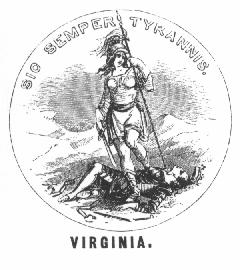
CLICK THE ABOVE ICON TO READ THE COMPLETE HISTORY FOLDER
C586. IDENTIFIED VIRGINIA 9th CAVALRY - CONFEDERATE BRASS HILT PATTERN 1853 CAVALRY SWORD: This Mole marked Confederate Brass Hilt Pattern 1853 Cavalry Saber was discovered in a home in Richmond Virginia with the remnants of an officer’s silk sash tied through the ring mounts. The sash is very dry; fragile and in a poor condition with holes and only one remaining tassel, and is powdery to touch and must be handled withcare. However, it is a strong indication the saber belonged to an officer.
On the top front are the initials R H P “RHP.”
A search of the Civil War data base found only one cavalry officer from Virginia with these initials: Robert Henry Pratt.
By profession, Robert Heny Pratt was a dentist when he initially enlisted in the Virginia 40th Infantry, but a few months later accepted a commission in “K” Company, Virginia 9th Cavalry.
He was listed as:
Wounded 9/13/1863 Culpeper Court House, VA (Gunshot wound in left hand)
Detached 10/15/1863 (place not stated) (On conscription duty)
Returned 6/15/1864 (place not stated) (Estimated day)
On rolls 9/1/1864 (place not stated) (Present through final roll)
Oath Allegiance 5/2/1865 Ashland, VA
Promotions:
1st Lieutenant 8/22/1861 (As of Co. K, 9th VA Cav)
Captain 9/15/1862 (Estimated day)
The Virginia’s 9th Cavalry Regiment was formed in January, 1862, using John E. Johnson's eight company 1st Battalion, Virginia Cavalry ("Lee's Legion") as its nucleus. These companies and the two added were from the counties of Stafford, Caroline, Westmoreland, Lancaster, Essex, Spotsylvania, Lunenburg, King William, King George, and Richmond.
The unit served in W.H.F. Lee's, Chambliss', and Beale's Brigade, Army of Northern Virginia.
It fought in the Seven Days' Battles and the conflicts at Gainesville, Second Manassas, Sharpsburg, Fredericksburg, Dumfries, Rapidan Station, Brandy Station, Upperville, Hanover, Gettysburg, Williamsport, Funkstown, and Culpeper Court House.
The 9th went on to fight at Bristoe, Mine Run, The Wilderness, and Todd's Tavern. Later it skirmished around Richmond and Petersburg, then was active in the Appomattox operations.
This unit reported 32 casualties at Upperville, lost four percent of the 490 engaged at Gettysburg, and had 22 disabled at Williamsport. It surrendered 1 officer and 26 men.
Click on the above Virginia state seal for the historical binder info on the Virginia 9th Cavalry and Robert Henry Pratt. The binder is included, as well as free shipping and insurance. $6500.00
******************************************************************************************************************************
) |
) |
) |
) |
) |
) |
) |
) |
) |
) |
) |
) |
) |
) |
) |
C585. CONFEDERATE – VIRGINIA CONTRACT PURCHASED AMES MODEL 1840 NCO SWORD: This is a Confederate – Virginia state contract purchased Ames Model 1840 NCO sword. Prior to succeeding from the Union, the state of Virgina contracted with Ames to purchase swords and sabers. All were dated 1860, but for those that were already US inspected, Virginia marked then with a secondary inspection 6-point star. On the M1840 NCO sword, the star mark was placed on the underside forward of the guard branch.
This sword has a heavy dark-brown patina on the brass and an even dark-gray patina on the blade. This has not had a scabbard on it since the war. The blade was period sharpened and has several small nicks the entire length of the blade, and is Ames maker marked and inspected “US JH 1860” which is how all Virginia contracted purchased NCO swords should be marked. The reverse clam-shell was period removed to make it easier to wear. With an original scabbard these swords sell in the $2000-$2500 range, but this is available for less. Shipping & Insurance included. $1200.00
******************************************************************************************************************************
) |
) |
) |
) |
) |
) |
) |
|
) |
) |
C598. CONFEDERATE - VIRGINIA CONTRACT AMES 1860 SABER: Produced by the Ames Manufacturing Company of Chicopee, Massachusetts this is a Model 1860 Light Cavalry saber with an uninspected blade dated “1860” on the ricasso. It is known that 1200 of the 5,000 sabers of this pattern produced under an 1859 Government contract, and dated “1860” on the ricasso, were shipped to the state of Virginia and used during the Civil War. These edged weapons are discussed on page 80 of John Thillmann’s work “CIVIL WAR CAVALRY & ARTILLERY SABERS.” In that section Mr. Thillmann states that the sabers were inspected, however, he also states that he knows of uninspected examples. Later researched determined that inspected examples need to have the addition of a six-point star Confederate inspection stamped on the pommel cap to be considered sent to Virginia, where as the uninspected example did go to Virginia.
This saber is the uninspected example with the Ames maker mark and only dated 1860. This hilt is tight with no movements and 98% original leather but no wire. The original blade washer holds the blade tight, and is period sharpen on the top half of the blade. The saber has never been cleaned and has even patina on the hilt and dark staining on the blade, but not pitted. The complete scabbard has a deep dark brown patina and wear on the drag. Overall, a fine example of a Confederate Virginia Contract Ames 1860 dated saber. Shipping & Insurance included. $1750.00
*****************************************************************************************************************************
) |
) |
) |
) |
) |
) |
) |
|
|
|
) |
) |
C603. CONFEDERATE "CORN PONE" CAVALRY SABER – COPPER/BRASS SCABBARD by LOUIS B. FROELICH: This style Confederate saber earned its distinctive name when it was sketched as Fig. 91 and described in Albaugh's original Confederate Edged Weapons book as being "As Southern as corn pone and molasses..." It has since been attributed to Louis B. Froelich from North Carolina. This saber is in near - mint ++ condition with 100% original leather grip; single strand wire; leather blade washer; and a copper scabbard with all original brass mounts.
The 33 1/2" blade has an unstopped fuller which runs from within 1" of the hilt and 9 1/2" of the tip. The blade is about perfect with no rust, pitting or edge nicks with an overall smooth gray patina with casting flaws, filling marks and period sharpening. The original leather washer is complete. The hilt is perfect with great untouched patina. The pommel cap is tight and the tang is undisturbed. This saber has never been apart and the wire and leather are tight around the cap and guard. It is identical in every detail to the one depicted by Albaugh with flat branches, small flat reverse counterguard, flat quillon, and collar at the base of the grip cast integral with the guard. It is slotted at the top of the guard for a sword knot. Often, this saber is found in a steel scabbard with brass mounts. However, this one has a copper scabbard with brass mounts, which is extremely rare, and some speculated that this could be an Officers saber.
The scabbard fits tight to the blade with virtually no movement. It has a crude lap seam along the back edge; a brass throat fastened by two rivets, brass ring mounts and iron carrying rings and a steel drag. The scabbard is completely untouched with traced of original lacquer finish and some minor areas a bumps and dings. This is a superb example of a North Carolina, Louis B. Froelich, “Corn pone” saber. Shipping & Insurance is free. $7500.00
*****************************************************************************************************************************
) |
) |
) |
) |
) |
) |
) |
) |
) |
) |
) |
) |
) |
) |
) |
C611. CONFEDERATE - SOUTH CAROLINA - KRAFT GOLDSCHMIDT & KRAFT SWORD: This is a Civil War Confederate Kraft Goldschmidt & Kraft Columbia South Carolina sword. Some believe it is an officer’s version because of the straighter and shorter blade with a steel scabbard, which makes it rarer and more desirable. The sword is 36 1/2 inch long with a 31-inch blade. This grip is 100% original leather with single strand steel wire and a brass ferrule common to KG&K swords. The 3-branch brass guard and pommel cap have matching deep reddish-brown patina, and show great casting flaws. The pommel cap, grip and blade are tight, but the guard is loose with side-to-side movement. The straight blade has a wavy unstopped fuller, and is more like a foot officer’s sword being shorter then a saber. It was not sharpened, but has some very minor nicks and a sharp point. The bottom seam scabbard is in great condition with original brass ring mounts and steel rings. The steel throat and drag both have lots of original lead. A similar example sold at auction for just under $7000.00. Shipping & Insurance included. $4600.00
*****************************************************************************************************************************
) |
) |
) |
) |
) |
) |
) |
) |
) |
) |
) |
) |
C620. CONFEDERATE – NEW ORLEANS MADE FOOT OFFICERS SWORD: This is an unmarked Confederate foot officers’ sword with all the characteristics of a sword made in New Orleans by Pradel. Pradel was a French maker who came to New Orleans in 1849 and established himself as a surgical instrument maker at 68 St. Charles Street. Pradel eventually partnered with his brother and moved, in 1861, to 121 Chartres Street where he was listed as a maker of surgical instruments and officers' swords.
The sword is 32 inches long with a 26 1/2-inch unetched blade. The blade is straight with a crude stopped fuller; casting flaws; and was period sharpened. The hilt is tight with 100% leather and wire; a crude sand-cast guard with a split pommel; a quillion design know for Pradel swords; and an undisturbed tang. The black leather scabbard is original to the sword and is 100% complete with all original brass fittings. Shipping & Insurance included. $4100.00
*****************************************************************************************************************************
) |
) |
) |
) |
) |
) |
) |
) |
) |
) |
|
|
|
) |
) |
) |
) |
) |
) |
) |
) |
C621. BOYLE & GAMBLE FOOT OFFICERS SWORD: This is an early Boyle & Gamble Foot Officers sword, which copied the open face guard produced by Ames and was a popular design with other Confederate sword makers. It is complete with the original scabbard. The hilt is tight with no movement and has an even dark mustard patina with an undisturbed tang. The grip is 100% complete with a little wear and crazing, and the single-strand brass wire is firm. The original leather blade washer holds the 28 1/4-inch blade tight. It has a single unstopped fuller; no visible etching; casting pits; a blunt tip; and was period sharpened. The leather scabbard is strong with no brakes or weak spots and is complete with the original staple-back plain design ring mounts and drag. Shipping & Insurance is included. $4200.00
*****************************************************************************************************************************
) |
) |
) |
) |
) |
) |
) |
) |
) |
) |
) |
) |
) |
) |
) |


C623. CONFEDERATE - THOMAS PRUETT ALABAMA D-GUARD: This Thomas Pruett Alabama D-Guard recently surfaced in Montgomery, Alabama and is fresh to the Antique Bowie Knife Collecting World. It is an unmarked example with a large forward single ferrule, but not one to the back. The blade also has the forging flaw near the center, which is another trait common to the Pruett blades. The guard has no movement and the grip is tight. It does have some stress cracks, but is solid. Also, the tang is undisturbed. It is a great example of a rare and desirable Confederate Fighting Knife. This Thomas Pruett Alabama D-Guard has been studied by other "KNIFE GUYS" and all agree it is made by Pruett. Marked examples often sell in the $10,000++ range. Shipping & Insurance included. $5500.00
*****************************************************************************************************************************
) |
) |
) |
) |
) |
) |
) |
) |
) |
) |
C624. CONFEDERATE - LARGE MASSIVE D-GUARD BOWIE KNIFE: This is a large massive D-Guard blacksmith Bowi knife with the original leather sheath. It is a beast of a knife! It is 24 inches long with a 19 1/4 x 2-inch-wide spear-point blade. The blade is period sharpened and has great casting flaws and the steel D-guard is tight and shaped like other Alabama knives with a small pointed quillion. It has an oak slab grip held with two stee pins and a forward steel ferrule. The knife is complete with the original leather sheath and does fit in it; however, it is fragile and best displayed off the knife. The sheath has lead rivets on the bottom seam, tin throat and drag, and is partially open on both the top and bottom. This Confederate D-Guard Bowie Knife with original leather sheath has all the expected wear from honest service and scream 1861. A plexiglass inserts is included to support the scabbard when displayed seperate from the knife. Shipping & Insurance included. $4550.00
*****************************************************************************************************************************
) |
) |
) |
) |
) |
) |
) |
) |
) |
) |
) |
) |
) |
) |
) |
) |
) |
) |
) |
) |
) |
) |
) |
) |
C664. CONFEDERATE - BOWIE FIGHTING KNIFE & TIN SHEATH: This is a great Confederate Bowie Fighting knife complete with its original tin sheath and Pig-Skin belt lop. The knife is 22 1/4 inches long with a 16 7/8-inch x 1 1/8-inch-wide blade. The tool grip handle is well made and penned tight at the tang with a hexagonal washer. There is an iron ferule before the thin S-shape guard, and great casting flaws and filling marks on the period sharpened blade. The tin sheath fits perfect to the blade and is well made with tight seams and lead filling. It also has the original pig-skin belt loop, which is very rare. Shipping & Insurance is included. $3600.00
******************************************************************************************************************************
) |
) |
) |
) |
) |
) |
) |
|
|
|
) |
) |
C665. CONFEDERATE - KENANSVILLE D-GUARD FIGHTING KNIFE: This is a newly discovered Confederate North Carolina Kenansville D-Guard fighting knife. The D-Guard design is unique to Louis Frolich and matches the guard depicted on the Kenansville Artillery Knife on pages 77 & 81 of the book: Confederate Bowie Knifes by Jack Melton, Josh Phillips& John Sexton. However, the blade is a never-before-seen style. The knife is 20 1/2 inches long with a 15 1/4-inch spear-point blade. The oak grip is original and you can see dark areas where the iron has leached into the wood. It is "penned tight" at the tang with no movement, and the patina is even and undisturbed. The blade has a ricasso with a choil end at the base. There are casting flaws and filling marks, and it is period sharpened. As with the guard, the patina on the blade is undisturbed. This is a rare and unique example of a Louis Frolich Kenansville D-Guard fighting knife, which is missing from any advance collection. Shipping & Insurance is included. $3500.00
******************************************************************************************************************************
) |
) |
) |
) |
) |
) |
) |
) |
) |
) |
) |
) |
C670. CONFEDERATE MISSISSIPPI SIDE KNIFE – SHORT SWORD: This Confederate Side Knife – Short sword was discovered in Mississippi and was brought to the Civil War show in Mansfield Ohio. It is 25 1/2 inches long with a 19 7/8 x 1 1/2 wide blacksmith made blade. It has great casting flaws and filling marks, and was period sharpened. The grip is solid wood with no breaks or cracks with a steel ferrule forward by the steel cross guard, and a brass cap held in place with 2 steel pins. The tang is undisturbed and peened tight. The leather sheath is will made is strongly made and has a belt strap that was made from an 1858 Pattern US Federal Infantry knapsack. I acquired this directly from a well-know Civil War dealer from Savannah, Tennessee. Shipping & Insurance is free. $2900.00
******************************************************************************************************************************
) |
) |
) |
) |
) |
) |
) |
) |
) |
) |
) |
) |
) |
) |
) |
C672. CONFEDERATE NAVAL CUTLASS ATTRIBUTED TO THE CSS FLORIDA – CAPTURED OFF THE CSS TEXAS: Collectors and students of Confederate edged weapons, especially those of the Confederate States Navy, will recognize this unique cutlass which has been attributed to the CSS Florida. However, this one has a GAR tag on it that documents it was taken off the CSS Texas when Richmond fell in 1865.
GAR TAG
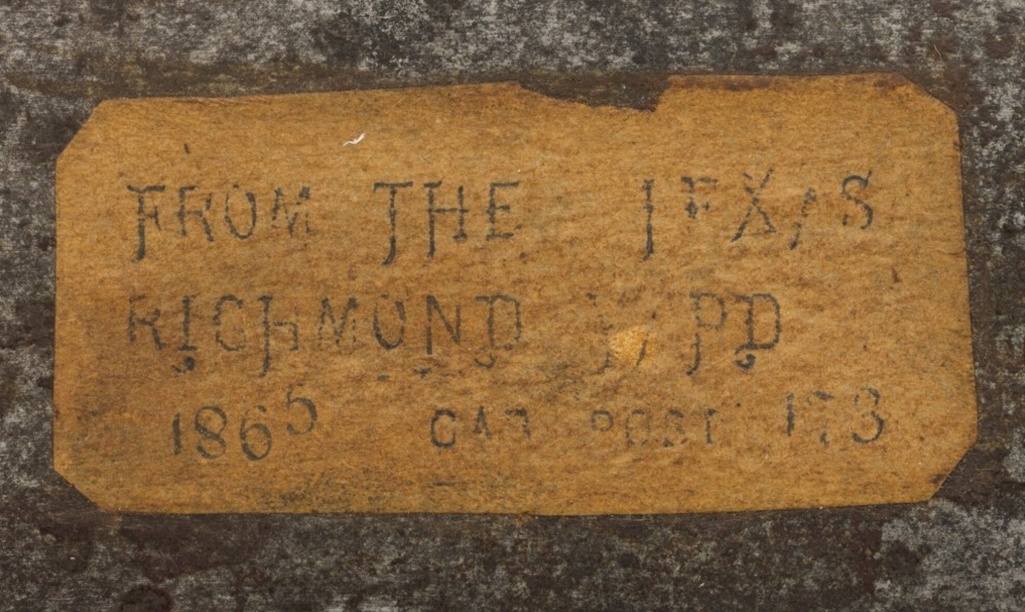
FROM THE TEXAS
RICHMOND YARD
1865 GAR POST 173
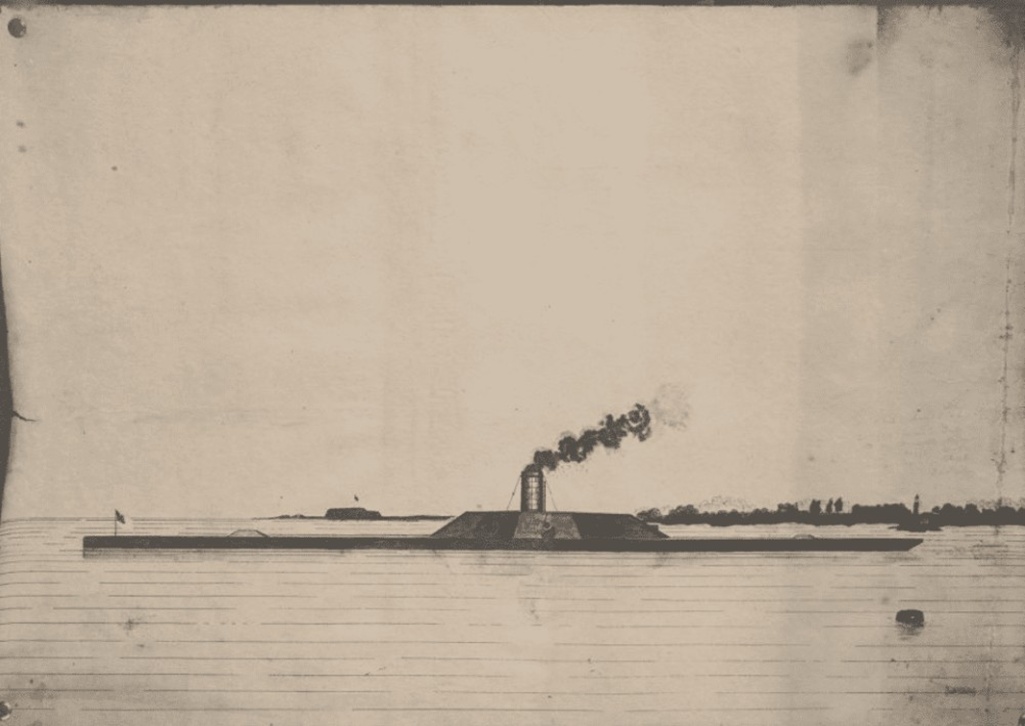
CSS Texas was the third and last Columbia-class (or Tennessee-class according to some sources) casemate ironclad built for the Confederate Navy during the American Civil War. Not begun until 1864 and intended to become part of the James River Squadron, she saw no action before being captured by Union forces while still fitting out. CSS Texas was reputed to have been one of the very best-constructed Confederate ironclads, second only to CSS Mississippi.
History
Designed by John L. Porter, the Confederacy's chief naval designer, CSS Texas belonged to an 1863/64 class of three ironclads, with CSS Tennessee (1863) (also referred to as the CSS Tennessee II) and CSS Columbia, all three slated to be sister ships. Of the three, only Tennessee was completed and commissioned, proving her mettle in the Battle of Mobile Bay. Columbia was launched but incapacitated while being completed, never seeing operational duty in the Civil War, despite later being captured, repaired, and appraised by the Union Navy.
The keel for CSS Texas was laid down at Rocketts Naval Yard, just outside Richmond, Virginia. She was launched in mid-January 1865, almost at exactly the same time as her unfinished sister ironclad Columbia was crippled beyond salvation. At the time of Robert E. Lee's evacuation of Richmond on 3 April 1865, she was left unfinished but still intact at the Richmond Navy Yard. She was one of only two vessels (the other being the small iron-hulled gunboat CSS Beaufort) which escaped destruction by retreating Confederate forces, because attempts to set her ablaze proved unsuccessful. Captured when Richmond fell the following day, both ironclad and gunboat were appropriated "for use in the Navy", as per Union Admiral David D. Porter (not related to the Texas designer). In his official report of April 12, 1865, Porter mentioned that he was informed that the engines and parts of her armor were not yet installed, residing undamaged but completed in the warehouses of the Richmond naval yard. He subsequently ordered all of it transported to the Norfolk Naval Shipyard, along with the ironclad. This task was begun on 3 May 1865 and completed the following day. Texas was towed downstream by three tugboats, accompanied by Union monitor USS Sangamon, commanded by Lieutenant Commander R. Chandler, who was in charge of the overall operation.
As the war was winding down, and unlike her captured sister ship Tennessee, Texas was not commissioned into the Union Navy. She saw no active service, except for a trial run on 22 June 1865 with her engines apparently installed, the one and only time Texas was known to have sailed under her own power. She was eventually laid up at the Norfolk yard until 15 October 1867, when she was sold at auction for scrapping to J. N. Leonard & Co. of New Haven, Connecticut, having originally cost $218,068 to construct.
Design
The casemate of Texas was roughly octagonal, rather than being a sloped, rectangular, armored box, as on earlier Confederate ironclads and including her class sisters; during construction, it was shortened and reshaped due to critical war materials shortages, accounting for the substantially reduced number of crew needed, when compared to her class sister CSS Tennessee II. The casemate fitted snugly around her eight gun-ports, six of which were to be used with two pivot cannons, each one firing from three forward and three aft gun port positions.
Details of her armament are sketchy, but her sister Tennessee II, carried four 6.4-inch (163 mm) Brooke rifles, two 7.0-inch (178 mm) Brooke rifles, and a bolted-on spar torpedo fitted to her bow. Tennessee II's armor was three layers of 2-inch (51 mm) iron plate, and instead of being bolted to her deck, the pilot house formed a seamless extension of her sloped side-armor. Tennessee II's top speed was about 5 knots (9.3 km/h; 5.8 mph), according to some sources, and her crew numbered about 133 sailors. However, it is unclear how closely Texas would have resembled her sister had she been completed, if at all, considering the shortages Texas had to contend with during construction.
Other sources gave Texas a (projected) top speed of about 10 knots (19 km/h; 12 mph). These note that both Tennessee II and Texas differed from each other in their final details due to a lack of available materials, notably the iron plate for her armor; her cannons and engines were also different. During construction, design improvements were also incorporated into Texas from lessons learned in combat with the Union Navy.
Particulars on her dimensions and propulsion, recorded by her Union captors, were later included as a statistical summary in the "Official Records of the Union and Confederate Navies in the War of the Rebellion". It was stated that she measured 217 feet in length, 48.6 feet abeam, and was designed to draw 13 feet of water and 13.6 feet when fully loaded. She was a twin-engine vessel, each driving a separate propeller, powered by two 22'(L)×8.4'(W)×9.1'(H) boilers, heated by a 7'(L)×3.6'(W) furnace, with a grate surface area of 96.8 sq. ft. Recorded is also an appraisal of an inspecting Union officer, who deemed Texas as "(...) one of the best and most valuable hulls built by the Rebels". It was only in this summary that the June 22 trial run was mentioned.
Commander Gerald C. Roxbury U.S. Navy (Retired) researched and wrote an outstanding article on this style cutlass. I have included a link to the article and you can read the details about this unique Confederate Naval Cutlass.
CLICK THE IMAGE BELOW TO READ COMMANDER ROXBURY'S ARTICLE
Here is an opportunity to add this unique Confederate Naval cutlass to your collection. Shipping & Insurance is free. $3800.00
******************************************************************************************************************************
) |
) |
) |
) |
) |
) |
) |
) |
) |
) |
) |
) |
) |
) |
) |
) |
) |
) |
C673. BOYLE & GAMBLE FOOT OFFICERS SWORD – ETCHED BLADE & ORIGINAL SCABBARD: This is an original Boyle & Gamble Foot Officers sword with a “CS” etched blade with its complete original scabbard. The hilt is tight and with 100% original leather and twisted wire with an undisturbed tang and an even pleasing patina. The 30 1/4” blade is period sharpened, has stippling its entire length, and has strong etching on the side with “CS” and weaker etching on the opposite side. Boyle & Gamble etching was lightly done and is often gone on must examples, or never etched. The blade fits perfect to the scabbard. The scabbard is top stitched with all original mounts and screws with original sword hangers on both ring mounts, and all have the same deep reddish-brown patina. This sword was carried by a proud Confederate officer and in great shape! Shipping & Insurance is included free. $6950.00
******************************************************************************************************************************
) |
) |
) |
) |
) |
) |
) |
) |
) |
) |
) |
) |
C676. CONFEDERATE SIDE-KNIFE & ORIGINAL TIN COVERED LEATHER SHEATH: This Confederate side knife has been in a Virginal collection for over 40 years and is fresh to the marked. It is complete with its original tin covered leather sheath. The knife is 13" inches long with an 8 1/4” inch spear-point blade made from a file. The blade was protected by the sheath and is bright as the day it was made; is period sharpened; and shows marks from the original file. The diamond shaped steel guard is held tight with a brass ferrule. The tool handle grip does have two stress fracture, but is tight with no movement. The sheath is leather and an outer tin body, which is well made. It fits like a glove, and is complete with the original tin belt loop. This is a fine examples of a Virginia made Confederate side knife is excellent condition. Shipping & Insurance is free. $2700.00
*****************************************************************************************************************************
) |
) |
) |
) |
) |
) |
) |
) |
) |
) |
) |
) |
C679. CONFEDERATE SIDE KNIFE & ORIGINAL SHEATH: This is an original Confederate Side Knife & Original Sheath. The knife is 17 1/4 inches long with a 13 x 1 1/4-inch spear-point blade. The oak-wood grip is tight with no issues; the steal guard is tight with great casting flaws and has faint period blue paint; and the tang is peened tight with a steel washer. The initial H J M are carved in the wood, but there are too many soldiers with these initials for an identification. The sheath fits perfect to the blade, but missing the hanging belt strap. Shipping & Insurance is free. $2900.00
******************************************************************************************************************************
****************************************************************
Remittance by Mail
Send to:
Arizona Swords
530 E. McDowell Road, Suite 107-160
Phoenix, AZ 85004
****************************************************************
Contact Number: (602) 245-4721
© 2004 Arizona Swords azswords.com. All rights reserved in all media.
)
)
)
)
)
)
)
)
)
)
)
)
)
)
)
)
)
)
)
)
)
)
)
)
)
)
)
)
)
)
)
)
)
)
)
)
)
)
)
)
)
)
)
)
)
)
)
)
)
)
)
)
)
)
)
)
)
)
)
)
)
)
)
)
)
)
)
)
)
)
)
)
)
)
)
)
)
)
)
)
)
)
)
)
)
)
)
)
)
)
)
)
)
)
)
)
